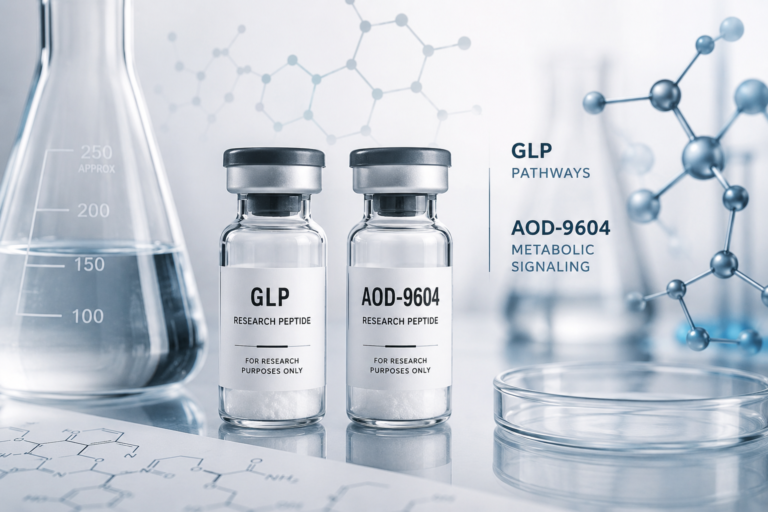
Educational Overview of GLP Research Options
Glucagon-like peptide-1 (GLP-1) signaling has become a major area of metabolic and endocrine research. Scientists have investigated the GLP-1 pathway for its roles in glucose-dependent insulin secretion, glucagon regulation, gastric function, appetite signaling, and communication between the gastrointestinal tract and central nervous system.
The research landscape has also expanded beyond GLP-1 receptor agonism alone. Compounds such as tirzepatide target both GIP and GLP-1 receptors, while investigational molecules such as retatrutide target three hormone receptors. Other compounds, including the amylin analog cagrilintide, are being investigated alongside GLP-1 receptor agonists as part of broader multi-pathway research.
These compounds differ substantially in receptor activity, evidence base, regulatory status, and stage of clinical development. Understanding those distinctions is essential when evaluating the scientific literature.
This article provides an educational overview of several prominent compounds associated with GLP-related metabolic research. It does not provide medical advice, treatment recommendations, dosing information, administration instructions, or guidance regarding human use of research materials.
What Is GLP-1?
GLP-1 stands for glucagon-like peptide-1, a naturally occurring peptide hormone produced primarily by intestinal enteroendocrine cells in response to nutrient intake.
GLP-1 participates in several aspects of metabolic regulation, including:
- Glucose-dependent insulin secretion
- Glucagon regulation
- Gastric emptying
- Appetite and satiety signaling
- Communication between the gastrointestinal tract and brain
A recent New England Journal of Medicine review of GLP-1 receptor agonists summarizes the physiology and pharmacology underlying this increasingly important area of metabolic research.
Native GLP-1 has a relatively short biological half-life because it is rapidly degraded by enzymes including dipeptidyl peptidase-4, or DPP-4. Researchers and pharmaceutical developers have therefore developed GLP-1 receptor agonists with structural modifications that extend biological activity.
It is important to distinguish the naturally occurring GLP-1 hormone from pharmaceutical GLP-1 receptor agonists and investigational compounds designed to interact with GLP-1 and other metabolic receptors.
Why Researchers Study GLP-1 Signaling
GLP-1 signaling connects several biological systems involved in nutrient sensing and metabolic regulation.
Research has examined GLP-1 receptor activity in relation to:
- Pancreatic endocrine function
- Glucose metabolism
- Appetite and food-intake regulation
- Gastric physiology
- Central nervous system signaling
- Energy homeostasis
- Cardiovascular and renal physiology
The field has progressed considerably beyond laboratory research. Multiple GLP-1 receptor agonists are FDA-approved pharmaceutical agents, and large randomized clinical trials have generated substantial human evidence regarding specific compounds and approved indications.
At the same time, newer compounds targeting combinations of GLP-1, GIP, glucagon, amylin, and other metabolic pathways remain active areas of investigation.
These different evidence levels should not be treated as equivalent.
Semaglutide
Semaglutide is a GLP-1 analog and selective GLP-1 receptor agonist. It shares substantial sequence similarity with human GLP-1 but incorporates structural modifications that increase resistance to degradation and prolong its biological half-life.
According to FDA-approved prescribing information for semaglutide, semaglutide selectively binds to and activates the GLP-1 receptor. Its prolonged activity is associated in part with albumin binding and increased resistance to DPP-4 degradation.
Research and clinical development involving semaglutide have examined:
- GLP-1 receptor signaling
- Glucose-dependent insulin secretion
- Glucagon regulation
- Gastric emptying
- Appetite and caloric intake
- Body-weight regulation
- Cardiometabolic outcomes
Semaglutide is not merely an experimental research peptide. FDA-approved prescription medications containing semaglutide exist for specific indications.
That regulatory distinction is important. FDA approval applies to specific pharmaceutical products, formulations, manufacturing processes, labeling, and indications. It should not be generalized to independently produced research-grade semaglutide materials.
Tirzepatide
Tirzepatide differs pharmacologically from semaglutide because it activates two incretin receptors rather than only the GLP-1 receptor.
The FDA describes tirzepatide as a GIP receptor and GLP-1 receptor agonist. It selectively binds to and activates receptors for both glucose-dependent insulinotropic polypeptide, or GIP, and GLP-1.
Research involving tirzepatide has examined:
- GIP receptor signaling
- GLP-1 receptor signaling
- Glucose-dependent insulin secretion
- Glucagon regulation
- Appetite and caloric intake
- Gastric emptying
- Metabolic and body-composition outcomes
The addition of GIP receptor activity makes tirzepatide mechanistically distinct from selective GLP-1 receptor agonists such as semaglutide.
Tirzepatide has also undergone extensive clinical development and is the active ingredient in FDA-approved prescription medications. As with semaglutide, that approval applies to regulated pharmaceutical products rather than research-grade materials bearing the same compound name.
Retatrutide
Retatrutide represents another step in the development of multi-receptor metabolic compounds.
Rather than targeting one or two receptors, retatrutide is designed as an agonist of three:
- GIP receptor
- GLP-1 receptor
- Glucagon receptor
A Phase 2 trial published in the New England Journal of Medicine described retatrutide as a GIP, GLP-1, and glucagon receptor triple agonist.
The inclusion of glucagon receptor activity distinguishes retatrutide from both semaglutide and tirzepatide and has generated substantial research interest in how simultaneous activation of multiple nutrient-responsive hormone pathways may affect metabolic regulation.
However, the regulatory distinction is critical:
Retatrutide remains an investigational compound and should not be described as an FDA-approved medication.
Its research program has included clinical investigation, so describing it simply as a “laboratory peptide” would also fail to represent the evidence accurately. The appropriate description is an investigational multi-receptor agonist undergoing clinical development.
Cagrilintide
Cagrilintide belongs to a different biological category.
It is not a GLP-1 receptor agonist. Cagrilintide is a long-acting analog of amylin, another peptide hormone involved in metabolic signaling.
Amylin is normally co-secreted with insulin by pancreatic beta cells and participates in physiological processes related to food intake, satiety, and gastric function.
Cagrilintide has attracted attention within GLP-related research largely because researchers have investigated the amylin and GLP-1 pathways together, including clinical development programs combining cagrilintide with semaglutide.
This makes cagrilintide relevant to a discussion of modern metabolic peptide research, but it should not be categorized as a GLP compound.
The distinction illustrates a broader trend in metabolic research: rather than modifying a single receptor pathway, researchers are increasingly investigating how multiple hormonal signaling systems can be targeted or studied simultaneously.
How Do These Research Options Differ?
The most fundamental distinction among these compounds is their receptor activity and regulatory status.
| Compound | Primary Receptor Activity | General Research Context |
|---|---|---|
| Semaglutide | GLP-1 receptor agonist | Extensive clinical evidence; FDA-approved products exist |
| Tirzepatide | GIP + GLP-1 receptor agonist | Extensive clinical evidence; FDA-approved products exist |
| Retatrutide | GIP + GLP-1 + glucagon receptor agonist | Investigational; clinical development |
| Cagrilintide | Amylin analog | Investigational; studied independently and with GLP-1 pathway compounds |
This comparison demonstrates why the broad phrase “GLP research options” requires some qualification.
Semaglutide and tirzepatide have reached regulatory approval for specific pharmaceutical products and indications. Retatrutide and cagrilintide represent areas of ongoing clinical investigation.
Their mechanisms also differ substantially, making direct comparisons based only on outcomes or popular discussion scientifically incomplete.
Single, Dual, and Triple Receptor Agonism
The evolution from selective GLP-1 receptor agonists toward multi-receptor compounds represents an important area of metabolic research.
A selective GLP-1 receptor agonist such as semaglutide primarily targets one receptor system.
Tirzepatide combines GIP and GLP-1 receptor agonism.
Retatrutide adds glucagon receptor agonism to GIP and GLP-1 receptor activity. The published Phase 2 trial describes the scientific rationale for investigating this triple-hormone-receptor approach.
Increasing the number of receptor targets does not automatically make a compound superior. Each additional signaling pathway introduces new pharmacological effects, interactions, research questions, and potential safety considerations.
Multi-receptor activity therefore needs to be evaluated experimentally rather than assumed to provide additive or synergistic benefits.
Why Regulatory Status Matters
One of the most important considerations when discussing these compounds is the distinction between an active pharmaceutical ingredient, an FDA-approved drug product, and an investigational research compound.
FDA approval involves evaluation of a particular drug product for defined indications, manufacturing specifications, formulation, labeling, and conditions of use.
The FDA currently recognizes approved GLP-1-related pharmaceutical products while also warning about unapproved products containing active ingredients such as semaglutide and tirzepatide.
Consequently, the existence of an FDA-approved medication containing a particular active ingredient does not establish that independently manufactured research material containing that ingredient is equivalent to the approved medication.
Likewise, clinical investigation of a compound such as retatrutide does not constitute FDA approval.
These distinctions are important for accurate scientific and regulatory communication.
Evaluating GLP-Related Research
Rather than asking which GLP-related compound is “best,” researchers evaluating the literature should consider the specific scientific question being investigated.
Relevant factors include:
- Receptor targets
- Molecular structure
- Pharmacological mechanism
- Experimental model
- Study population
- Research endpoints
- Pharmacokinetic characteristics
- Evidence quality
- Stage of clinical development
- Regulatory status
A finding involving semaglutide, for example, should not automatically be generalized to tirzepatide simply because both activate GLP-1 receptors.
The same principle becomes even more important when evaluating retatrutide or cagrilintide because additional receptor systems are involved.
Combination and Multi-Pathway Research
Modern metabolic research increasingly investigates interactions among multiple hormonal pathways.
These include signaling associated with:
- GLP-1
- GIP
- Glucagon
- Amylin
- Other nutrient-responsive hormones
This can occur through a single molecule engineered to activate multiple receptors, as with tirzepatide or retatrutide, or through research involving separate compounds targeting different pathways.
These approaches should not be assumed to be equivalent.
A purpose-designed multi-receptor molecule has defined pharmacological characteristics that differ from simply combining separate research compounds. Claims regarding synergy, complementary effects, or improved outcomes require direct experimental evidence.
Prism Peptides does not provide guidance regarding combinations, dosing protocols, or administration of research compounds.
The Future of GLP-Related Research
GLP-related science continues to develop rapidly.
A 2026 New England Journal of Medicine review notes that research has expanded beyond glucose and body-weight outcomes to include cardiovascular, renal, and other physiological questions, while newer multi-receptor approaches continue to be investigated.
Areas likely to remain scientifically important include:
- Multi-receptor agonist pharmacology
- Interactions among nutrient-responsive hormone systems
- Central nervous system signaling
- Metabolic adaptation
- Cardiovascular and renal physiology
- Body-composition research
- Long-term receptor biology
- Differences among individual receptor agonists
As these fields develop, regulatory status and evidence quality will continue to change. Articles discussing investigational compounds should therefore be reviewed periodically to ensure that descriptions remain current.
Final Thoughts
“GLP research” now encompasses substantially more than the study of a single hormone or receptor.
Semaglutide selectively activates the GLP-1 receptor. Tirzepatide activates both GIP and GLP-1 receptors. Retatrutide is being investigated as a GIP, GLP-1, and glucagon receptor triple agonist. Cagrilintide belongs to a separate pathway as an amylin analog but is relevant because of research examining amylin and GLP-1 signaling together.
These differences make receptor pharmacology, evidence quality, clinical-development stage, and regulatory status essential when comparing the compounds.
As metabolic science continues to evolve, responsible interpretation requires distinguishing FDA-approved pharmaceutical products from investigational compounds and avoiding assumptions that findings involving one receptor agonist apply to another.
We welcome suggestions for future educational and research-focused blog content. Send your ideas to [email protected].
Research Use Disclaimer: This content is provided strictly for informational and research purposes only. It does not constitute medical advice, diagnosis, treatment guidance, dosing information, or administration instructions. Products referenced by Prism Peptides are research-grade lyophilized powders that may require reconstitution as part of controlled laboratory procedures. They are intended solely for laboratory research and are not for human, veterinary, diagnostic, therapeutic, or household use.
Prism Peptides is not a medical provider, compounding pharmacy under Section 503A, or outsourcing facility under Section 503B. Statements concerning research compounds have not been evaluated by the U.S. Food and Drug Administration and are not intended to diagnose, treat, cure, or prevent any disease. Purchasers must be 21 years of age or older and must follow all applicable laws, regulations, safety requirements, and institutional research protocols.