BPC-157 and TB-500: Research, Mechanisms, and Scientific Interest
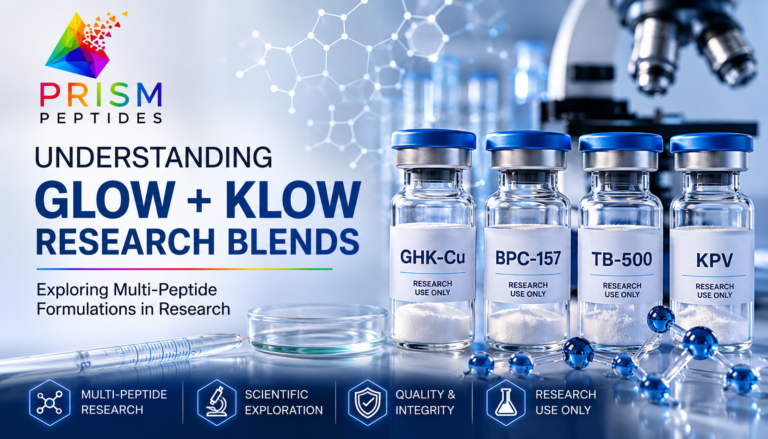
BPC-157 and TB-500 are frequently discussed together in peptide research, particularly in conversations involving tissue biology, cellular migration, angiogenesis, and experimental models of repair. However, the two compounds have different origins, structures, and evidence bases.
BPC-157 is a synthetic 15-amino-acid peptide that has been investigated predominantly in laboratory and animal studies. TB-500 is associated with research involving thymosin beta-4 (Tβ4), a naturally occurring 43-amino-acid peptide with well-characterized roles in actin biology and cellular movement.
An important distinction is that research involving full-length thymosin beta-4 should not automatically be attributed to TB-500. This distinction is sometimes lost in general discussions of these compounds.
This article provides an educational overview of BPC-157, TB-500, and thymosin beta-4-related research, including their biological origins, proposed mechanisms, evidence limitations, and areas of scientific interest.
For a broader introduction to peptide biology, see our Peptides 101 research guide.
What Is BPC-157?
BPC-157 is a synthetic pentadecapeptide, meaning it consists of 15 amino acids. It has been described in the scientific literature as a peptide sequence associated with a gastric protein or “body protection compound.”
Research involving BPC-157 has examined experimental models related to:
- Tendon and ligament biology
- Skeletal muscle
- Gastrointestinal tissues
- Fibroblast migration
- Angiogenic signaling
- Nitric oxide-related pathways
- Cellular responses to experimental injury
A recent systematic review of BPC-157 in musculoskeletal research found that the evidence base was overwhelmingly preclinical. Of 36 studies included in that review, 35 were preclinical, and only one was classified as a clinical study.
That imbalance is important when interpreting statements about BPC-157. Findings observed in cells or animal models should not be presented as established human outcomes.
BPC-157 and Cellular Migration
One area of BPC-157 research involves fibroblasts, cells that contribute to extracellular matrix production and connective-tissue biology.
An experimental study involving rat Achilles tendon explants and cultured tendon fibroblasts found that BPC-157 was associated with increased tendon fibroblast outgrowth, survival under experimental stress, and cell migration. The investigators also reported changes involving FAK and paxillin signaling.
These findings provide a mechanistic basis for some of the scientific interest in BPC-157 and connective-tissue research.
However, this type of experiment should be interpreted according to its model. Cellular migration observed in cultured fibroblasts does not by itself establish an equivalent effect in humans.
BPC-157 and Angiogenic Signaling
Angiogenesis is the biological process through which new blood vessels develop from existing vasculature. It involves coordinated signaling among endothelial cells, extracellular matrix components, growth factors, and other molecular systems.
BPC-157 has been investigated in preclinical research involving angiogenic pathways. Recent reviews of the literature discuss proposed mechanisms involving VEGF-related signaling and the Akt-eNOS pathway, among others.
A 2025 review of BPC-157 research and evidence limitations discusses angiogenesis, fibroblast activity, nitric oxide-related signaling, and other proposed mechanisms while also emphasizing the scarcity of rigorous human evidence.
These mechanisms remain areas of investigation rather than established therapeutic effects.
BPC-157 and Nitric Oxide Research
Nitric oxide, or NO, is an important signaling molecule involved in vascular biology and numerous other physiological processes.
Experimental BPC-157 literature has examined possible interactions with nitric oxide-related pathways. This research contributes to hypotheses regarding vascular signaling and other biological responses observed in preclinical models.
However, BPC-157 appears to interact with multiple signaling systems, and its precise mechanisms remain incompletely characterized.
For that reason, it is more accurate to describe nitric oxide signaling as one investigated component of BPC-157 biology, rather than assigning the peptide a single established mechanism of action.
What Is TB-500?
TB-500 requires more careful terminology than is often used in general peptide discussions.
Thymosin beta-4 is a naturally occurring 43-amino-acid peptide found widely in mammalian cells and tissues. It is particularly well known for its interaction with actin, an essential component of the cellular cytoskeleton.
TB-500, by contrast, is associated with a synthetic fragment of thymosin beta-4 rather than being synonymous with the complete naturally occurring peptide.
This distinction matters because a substantial portion of the scientific literature commonly cited in discussions of TB-500 actually investigates full-length thymosin beta-4.
The FDA, for example, separately identifies a thymosin beta-4 fragment among bulk drug substances it has evaluated in the compounding context.
Consequently, findings involving thymosin beta-4 should not automatically be represented as evidence specifically establishing the activity of TB-500.
Thymosin Beta-4 and Actin
One of the best-characterized biological functions of thymosin beta-4 involves its interaction with actin.
Actin contributes to:
- Cell structure
- Cytoskeletal organization
- Cell migration
- Cell adhesion
- Intracellular movement
- Numerous dynamic cellular processes
Thymosin beta-4 binds monomeric G-actin and participates in regulation of the balance between actin polymerization and depolymerization.
A detailed review of thymosin beta-4 and actin biology describes Tβ4 as a major G-actin-sequestering molecule and discusses how this interaction can influence cellular motility, differentiation, and other biological functions.
This represents a substantially stronger mechanistic foundation than simply describing TB-500 as a general “recovery peptide.”
Thymosin Beta-4 and Cellular Migration
Because actin dynamics are fundamental to cell movement, thymosin beta-4 has also been studied extensively in relation to cellular migration.
A review of the beta-thymosin family describes their involvement in actin regulation and cell migration, while noting that the underlying molecular biology is complex and not completely understood.
Cell migration is relevant to numerous biological processes, including development, vascular biology, tissue organization, and cellular responses to injury.
Again, evidence involving full-length Tβ4 should be distinguished from evidence specifically involving TB-500 or individual Tβ4 fragments.
Thymosin Beta-4 and Angiogenesis
Angiogenesis is another major area of thymosin beta-4 research.
Experimental studies have investigated the effects of Tβ4 on endothelial cell migration, vascular development, extracellular matrix remodeling, and new vessel formation.
One study identified a short actin-binding region of thymosin beta-4 as important to its observed angiogenic activity. Researchers examined endothelial cell migration and vascular sprouting using experimental models.
A broader review of thymosin beta-4 and vascular biology discusses its reported roles in vasculogenesis, angiogenesis, vascular stability, endothelial-cell behavior, and extracellular matrix remodeling.
These findings help explain why thymosin beta-4-related compounds attract interest in regenerative-biology research.
They do not, however, establish that every fragment derived from Tβ4 reproduces all of the biological activities of the full-length peptide.
Why Are BPC-157 and TB-500 Often Discussed Together?
BPC-157 and TB-500 frequently appear together in online discussions because the research associated with BPC-157 and thymosin beta-4 overlaps in several broad areas.
These include:
- Cellular migration
- Angiogenesis
- Connective-tissue biology
- Cytoskeletal and extracellular matrix processes
- Experimental models of tissue remodeling
For additional context on this broader research category, see our overview of recovery peptide research.
Despite these overlapping research themes, there is not sufficient evidence to assume that BPC-157 and TB-500 have complementary or synergistic effects.
They are structurally distinct compounds associated with different biological pathways.
BPC-157 research has examined pathways involving fibroblast migration, angiogenic signaling, nitric oxide biology, and other cellular mechanisms. Thymosin beta-4 research has a particularly well-characterized connection with actin dynamics, cytoskeletal organization, cellular migration, and vascular biology.
The fact that two compounds are investigated in related areas does not establish that combining them produces an additive or enhanced biological response.
Prism Peptides does not provide guidance regarding combinations, dosing protocols, or administration of research compounds.
BPC-157 vs. TB-500: Research Comparison
| Research Characteristic | BPC-157 | TB-500 / Tβ4-Related Research |
|---|---|---|
| General structure | Synthetic 15-amino-acid peptide | TB-500 is associated with a fragment of 43-amino-acid thymosin beta-4 |
| Biological research origin | Gastric protein-associated sequence | Thymosin beta-4 |
| Fibroblast/cell migration | Investigated | Investigated extensively for Tβ4 |
| Actin regulation | Not its defining mechanism | Major established feature of Tβ4 biology |
| Angiogenesis | Investigated preclinically | Extensively investigated for Tβ4 |
| Connective-tissue models | Investigated | Investigated |
| Human evidence | Very limited | Tβ4 has human/clinical literature, but this should not automatically be attributed to TB-500 |
| FDA-approved therapeutic use in the U.S. | None | None for TB-500 |
The distinction in the final two rows is especially important.
There is a broader scientific literature involving full-length thymosin beta-4, including clinical investigation. That does not mean equivalent evidence exists for TB-500.
Current Evidence and Research Limitations
The evidence bases for BPC-157 and TB-500 should not be treated as equivalent, and neither should be described as having established therapeutic effects based on the available research.
For BPC-157, recent systematic and narrative reviews emphasize that most published evidence remains preclinical and that rigorous human research is extremely limited.
For TB-500, another problem arises: much of the commonly cited literature concerns full-length thymosin beta-4 rather than TB-500 itself.
Researchers and readers should therefore ask several questions when evaluating a paper:
- Was the experiment conducted in cells, animals, or humans?
- Did researchers study BPC-157, TB-500, full-length thymosin beta-4, or a specific Tβ4 fragment?
- What molecular endpoint was measured?
- Was the study independently replicated?
- Does the cited evidence actually support the claim being made?
These distinctions are essential for avoiding conclusions that extend beyond the available evidence.
Regulatory and Quality Considerations
Neither BPC-157 nor TB-500 is an FDA-approved therapeutic drug in the United States.
The FDA has also specifically identified BPC-157 and a thymosin beta-4 fragment among bulk substances that raise significant safety concerns in the compounding context. FDA materials cite concerns including insufficient safety information and, for certain peptide substances, potential issues involving impurities, aggregation, characterization, and immunogenicity.
This is another reason that research-grade materials should not be conflated with FDA-approved pharmaceutical products.
For laboratories evaluating research materials, analytical characterization, lot-specific documentation, identity verification, purity, storage, and handling are separate considerations from the biological findings reported in published studies.
For more information, see our guide to peptide sourcing, quality, and analytical documentation.
Final Thoughts
BPC-157 and TB-500 are frequently discussed together, but scientifically responsible evaluation requires treating them as distinct research compounds.
BPC-157 is a synthetic 15-amino-acid peptide investigated predominantly through preclinical models involving fibroblast migration, angiogenic signaling, connective tissues, gastrointestinal biology, and other cellular pathways.
TB-500 is associated with thymosin beta-4-derived research, but it should not be treated as synonymous with full-length thymosin beta-4. Tβ4 itself has a substantial scientific literature involving actin regulation, cell migration, vascular biology, and tissue remodeling, while evidence specifically attributable to TB-500 is more limited.
The overlap between these research areas explains why the compounds are frequently discussed together. It does not establish that combining them produces synergistic, complementary, or clinically meaningful effects.
Careful attention to the exact compound studied, experimental model, research endpoint, evidence quality, and regulatory status remains essential when interpreting the scientific literature surrounding either peptide.
We welcome suggestions for future educational and research-focused blog content. Send your ideas to [email protected].
Research Use Disclaimer: This content is provided strictly for informational and research purposes only. It does not constitute medical advice, diagnosis, treatment guidance, dosing information, or administration instructions. Products referenced by Prism Peptides are research-grade lyophilized powders that may require reconstitution as part of controlled laboratory procedures. They are intended solely for laboratory research and are not for human, veterinary, diagnostic, therapeutic, or household use.
Prism Peptides is not a medical provider, compounding pharmacy under Section 503A, or outsourcing facility under Section 503B. Statements concerning research compounds have not been evaluated by the U.S. Food and Drug Administration and are not intended to diagnose, treat, cure, or prevent any disease. Purchasers must be 21 years of age or older and must follow all applicable laws, regulations, safety requirements, and institutional research protocols.